The latest housing policy changes sound simple: income ceilings are going up, families with children will receive more ballot chances, and the next BTO launch has been moved to November 2026.
But for most homeowners and buyers, the real question is not:
What changed?
It is:
Does this change what my family should do next?
For some households, the answer could be yes. A couple who previously earned slightly too much for a BTO may now qualify. A resale buyer may regain access to a CPF Housing Grant. A family with children may have better odds when applying for a new flat.
However, qualifying for an option does not automatically make it the right option. Let us break down the changes in simple terms, then look at the decisions that still matter.
The Changes At A Glance
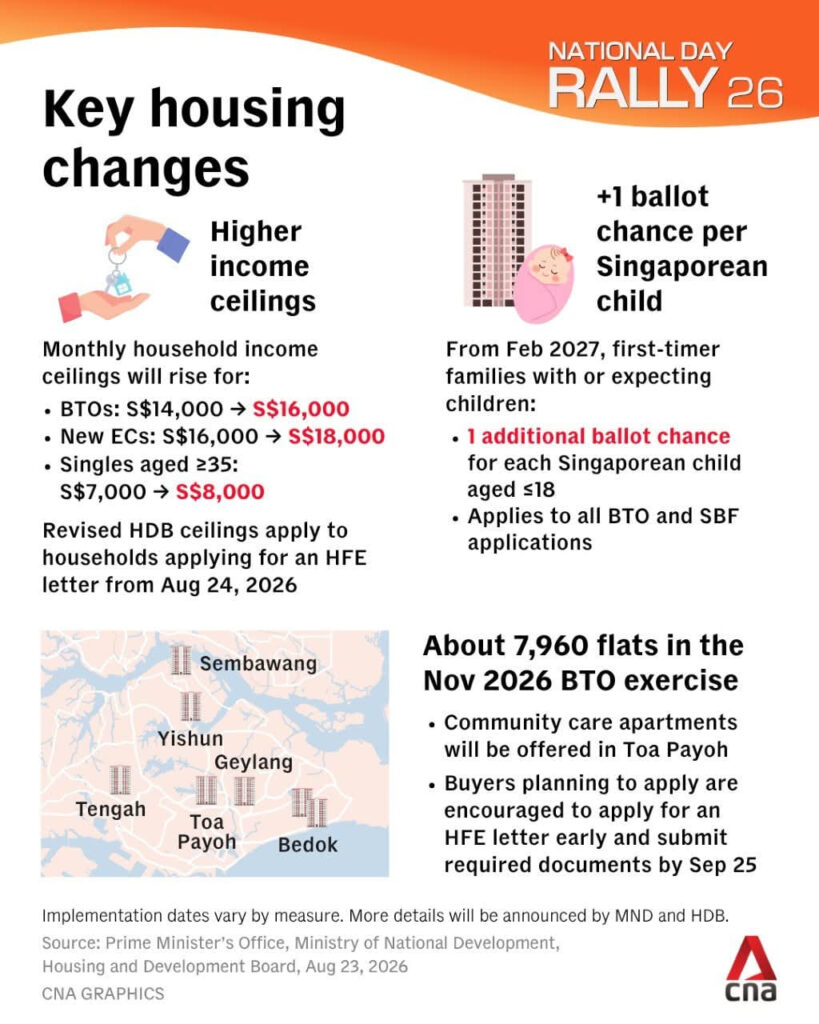
The higher ceilings will also affect eligibility for certain housing schemes and CPF Housing Grants.
There is also additional support for first-timer families with children. From February 2027, they will receive one additional ballot chance for every Singaporean child aged 18 or below when applying for a BTO or Sale of Balance Flats exercise.
These are meaningful changes, but each one needs to be interpreted carefully.
1. If your household earns between $14,000 and $16,000, BTO is an option again

Before this change, a family earning more than $14,000 a month would generally be above the BTO income ceiling. Their choices would usually shift towards an HDB resale flat, an EC or private property.
With the ceiling raised to $16,000, some of these households can now consider a BTO again.
For example, imagine a couple earning a combined $15,000 a month. Previously, they may have ruled out BTO completely. Now, they may be able to compare:
- A subsidised BTO with a longer waiting period
- A resale flat that is available sooner
- An EC with a higher purchase price and longer financial commitment
This is where the policy creates choice, not an automatic answer.
A BTO may have a lower entry price, but the family must consider the waiting time, location, flat classification, Minimum Occupation Period and whether the home will still suit them several years later.
A resale flat may cost more, but it gives them greater control over location, size and timing. That can matter if they need to live near parents, move closer to a school or require a larger home immediately.
The right comparison is therefore not simply:
Which property is cheaper?
It is:
Which option fits our finances and life plans after accounting for the trade-offs?
2. A higher income ceiling does not mean everyone receives a bigger grant

This is one of the easiest parts of the announcement to misunderstand.
The higher ceiling may allow more households to qualify for certain CPF Housing Grants when buying a resale flat. But that does not mean every newly eligible buyer will automatically receive the maximum grant amount.
Grant eligibility and grant amount can depend on factors such as:
Whether you are a first-timer or second-timer
Whether you are buying as a family or single
The type and size of resale flat
Your average household income
Whether you are living with or near your parents or children
The remaining lease of the flat
The Enhanced CPF Housing Grant is also income-tiered. In simple terms, a household at the upper end of the income ceiling should not assume that it will receive the same support as a lower-income household.
So before deciding that a resale flat has become more affordable, obtain or update your HDB Flat Eligibility letter and work out three separate numbers:
The grants you actually qualify for
The loan amount you can obtain
The cash and CPF you will still have after the purchase
The third number is often overlooked. A household may be technically able to complete the purchase but be left with too little buffer for renovation, children, emergencies or future interest-rate changes.
Eligibility tells you what you are allowed to buy. Financial planning tells you what you can comfortably own.
3. Families with children will receive more ballot chances, but it is not a guaranteed queue number
From February 2027, eligible first-timer families will receive one additional ballot chance for each Singaporean child aged 18 or below when applying for BTO or Sale of Balance Flats.
Here is a simplified illustration:
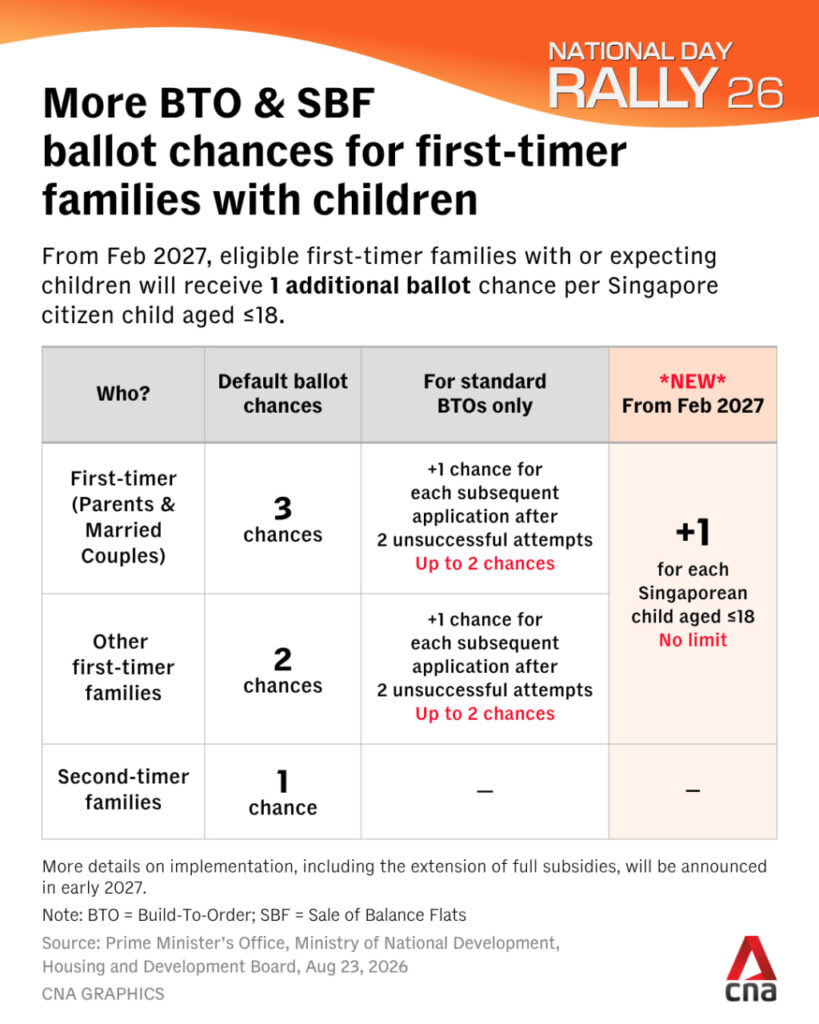
This gives growing families a stronger chance relative to applicants with fewer ballot chances. However, it is important to understand what an additional chance means.
It improves your odds. It does not guarantee success.
Your actual prospects will still depend on factors such as:
- How many people apply for that project and flat type
- The number of flats available
- The allocation for the relevant applicant group
- Whether you qualify under other priority schemes
This matters because families should not build their entire housing timeline around one highly popular project. If a child is starting school soon, a lease is ending or the current home is already too small, it is sensible to have a Plan B.
That Plan B could be another BTO location, a Sale of Balance Flat or a resale home. Better ballot odds are helpful, but certainty and timing also have value.
5. The EC ceiling has risen to $18,000, but affordability & new EC rules remains the real filter

The EC income ceiling will rise from $16,000 to $18,000. This allows more middle-income households to consider a new EC.
For a family previously caught between public and private housing, this may feel like the missing option. But EC buyers should be especially careful not to confuse higher eligibility with comfortable affordability.
The practical questions are:
- How much cash and CPF is required for the downpayment and purchase costs?
- What will the monthly instalment be under a conservative interest-rate assumption?
- How much savings will remain after the purchase?
- Can the household still manage the instalment if one income is temporarily reduced?
- How long will the family be committed to the property under the applicable rules?
- What resale competition could the unit face later?
The maximum loan a bank is prepared to offer is a limit, not a recommended budget.
However, take note of the recent EC rules: the MOP has doubled to 10 years and the deferred payment scheme is gone!
For more info on the New EC Rules… [CLICK HERE]
What could these changes mean for the wider market?

It is reasonable to expect more buyers to reconsider BTOs, resale flats and ECs now that the income ceilings have expanded. But it would be too simplistic to say that the policy will automatically push every housing segment up.
The effect will depend on how demand is distributed.
Some households may move from resale back to BTO because they qualify again. Others may stay with resale because they cannot wait. Some may consider an EC, while others may decide that the monthly commitment is still too high.
In other words, the announcement increases the number of options available. It does not remove the trade-offs between price, location, waiting time, space and financial safety.
Our Perspective

The NDR 2026 housing changes give more Singaporeans access to subsidised housing, grants and ECs. That is good news, especially for households that were previously just above the income ceilings and for growing families trying to secure a home.
But the policy has changed your eligibility, not necessarily your best decision.
The right move still depends on your income, savings, current property, family timeline, preferred location and how much flexibility you want to preserve for the future.
If these changes have reopened an option you previously ruled out, we can help you compare the numbers properly. Over coffee, we can review your current situation, the grants and financing available to you, the trade-offs between BTO, resale and EC, and the blind spots that may affect your next move.
The goal is not to push you towards a particular property. It is to help you understand which path gives your family the clearest and most comfortable way forward.
If you are considering buying, selling or repositioning your property portfolio…