When buyers compare new launches in Singapore, one number tends to dominate the conversation:
PSF.
$2,500 psf sounds cheaper than $2,800 psf.
$2,800 psf sounds cheaper than $3,000 psf.
Naturally, we assume the lower PSF represents better value.
But we think there is a more useful question to ask:
How big is the price gap between what you’re considering and what else your money can buy?
That distinction becomes particularly important when evaluating a project such as Thomson Reserve.
Because instead of asking whether $3,000 psf is expensive in isolation, we’d rather ask:
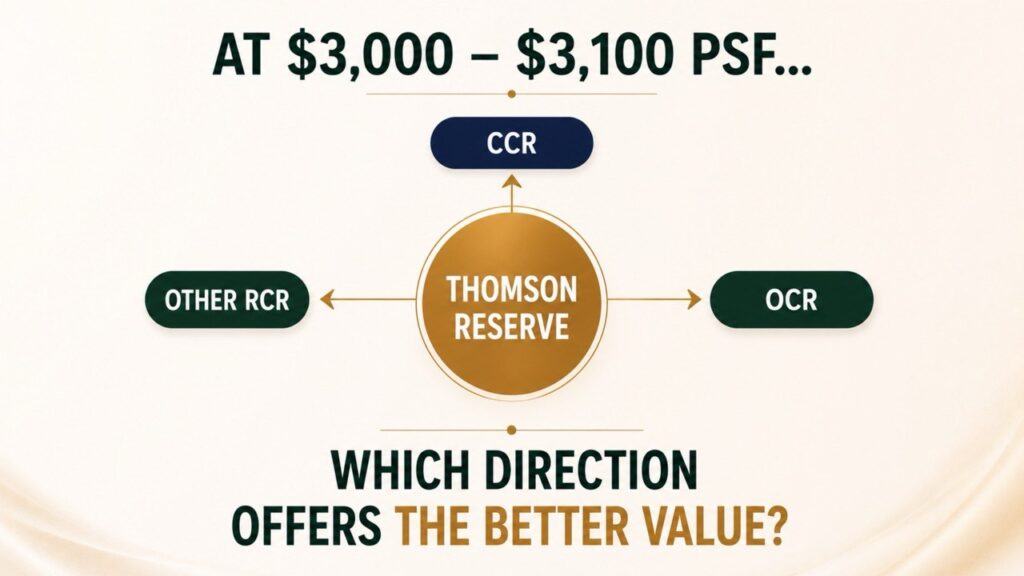
If Thomson Reserve eventually reaches $3,000 to $3,100 psf, what alternatives would buyers have at that point?
That is where what we call the PSF Gap Rule comes in.
Don’t Look at PSF in Isolation
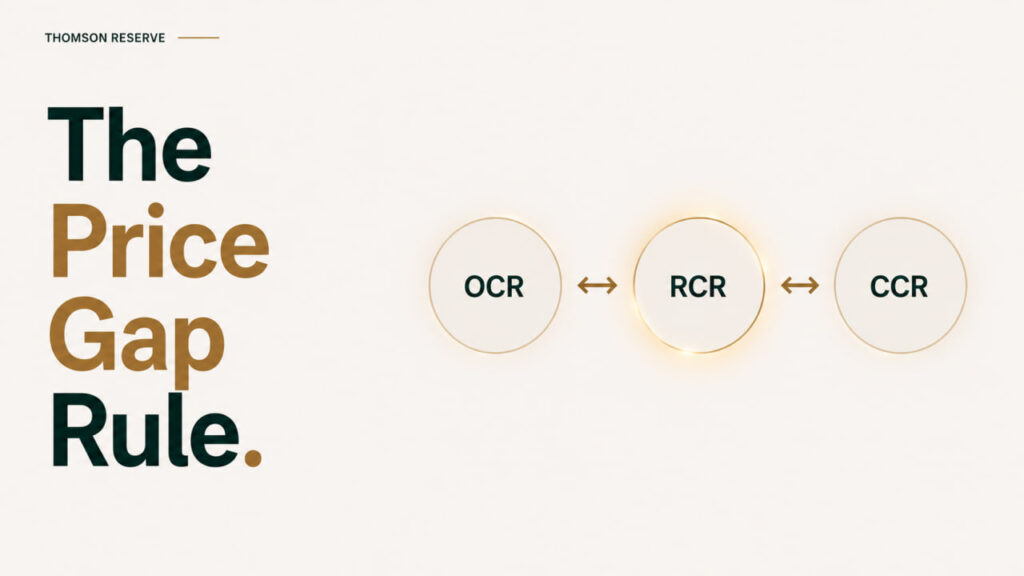
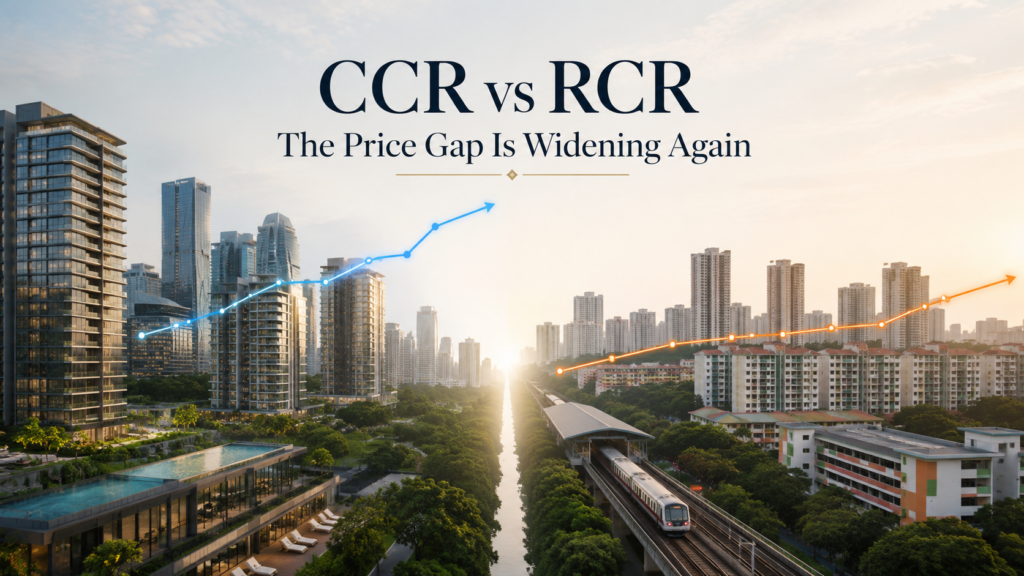
Singapore’s private residential market is commonly divided into three regions:
CCR — Core Central Region
RCR — Rest of Central Region
OCR — Outside Central Region
Historically, buyers might expect a relatively straightforward hierarchy.
CCR commands the highest PSF, followed by RCR, then OCR.
But property markets don’t always move neatly together.
At different points in the market cycle, the price gap between these regions can expand or contract.
And when that happens, the alternatives available to a buyer can change dramatically.
This is why we don’t think buyers should simply say:
“This is RCR, so this PSF is reasonable.”
The region tells you where the property is.
It doesn’t automatically tell you whether you’re getting good relative value.
A Real Example: RCR vs CCR at Almost the Same PSF
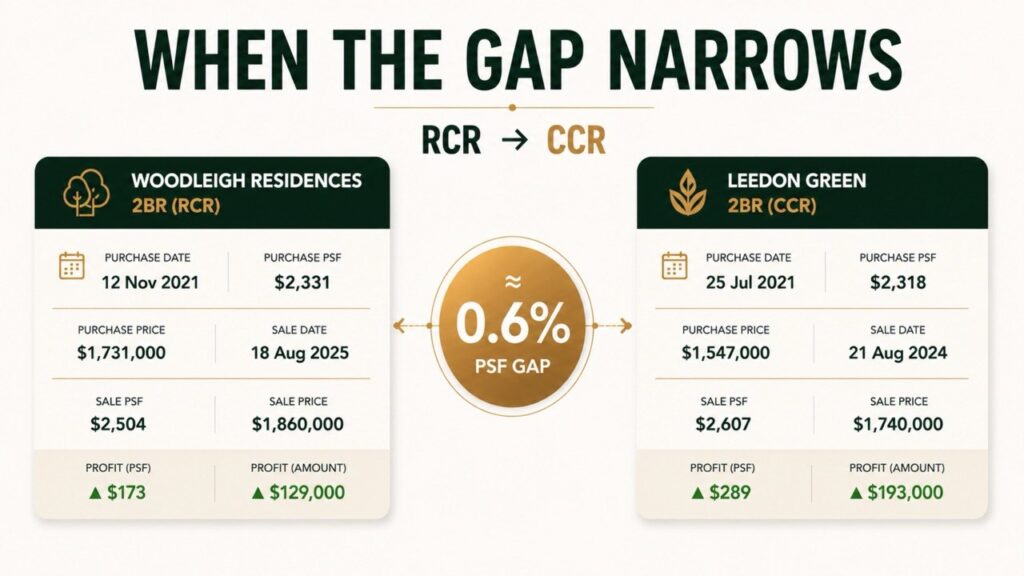
Here’s an interesting comparison we found when studying past transactions.
A 2-bedroom unit at Woodleigh Residences, in the RCR, was purchased in November 2021 at:
$2,331 psf
Meanwhile, a 2-bedroom unit at Leedon Green, in the CCR, was purchased in July 2021 at:
$2,318 psf
That’s only around a:
0.6% PSF gap.
Think about what that means.
At that point in time, a buyer looking at an RCR property could potentially have considered a CCR alternative at almost the same entry PSF.
This doesn’t automatically mean Leedon Green was the better purchase.
The developments have different locations, layouts, unit sizes, attributes and buyer profiles.
But a 0.6% gap should at least trigger another question:
If I can enter a different market segment at almost the same PSF, should I be comparing it before I commit?
That’s the thinking we want buyers to develop.
What Happens When the Gap Becomes Bigger?
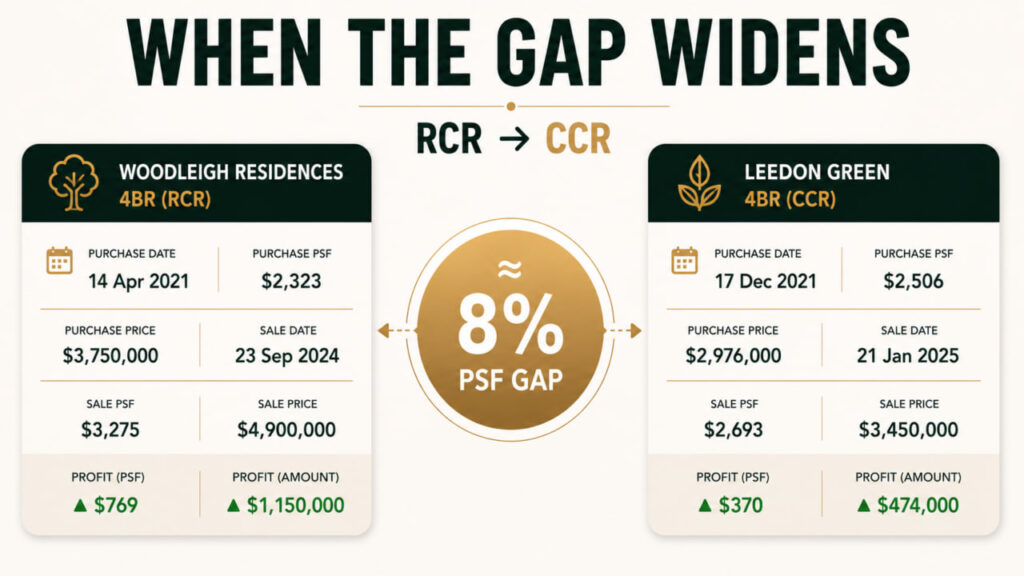
Now look at the same idea using larger units.
A 4-bedroom Woodleigh Residences unit was purchased in April 2021 at:
$2,323 psf
A 4-bedroom Leedon Green unit was purchased in Dec 2021 at:
$2,506 psf
The difference was approximately:
8%
The CCR alternative now required a clearer premium.
But it was still close enough that we’d want to understand what that extra 8% actually bought.
Location?
Land value?
Future buyer profile?
Scarcity?
Or simply a more expensive product?
This is where property analysis becomes much more interesting than simply comparing which project has the lower PSF.
And What If You Look in the Other Direction?
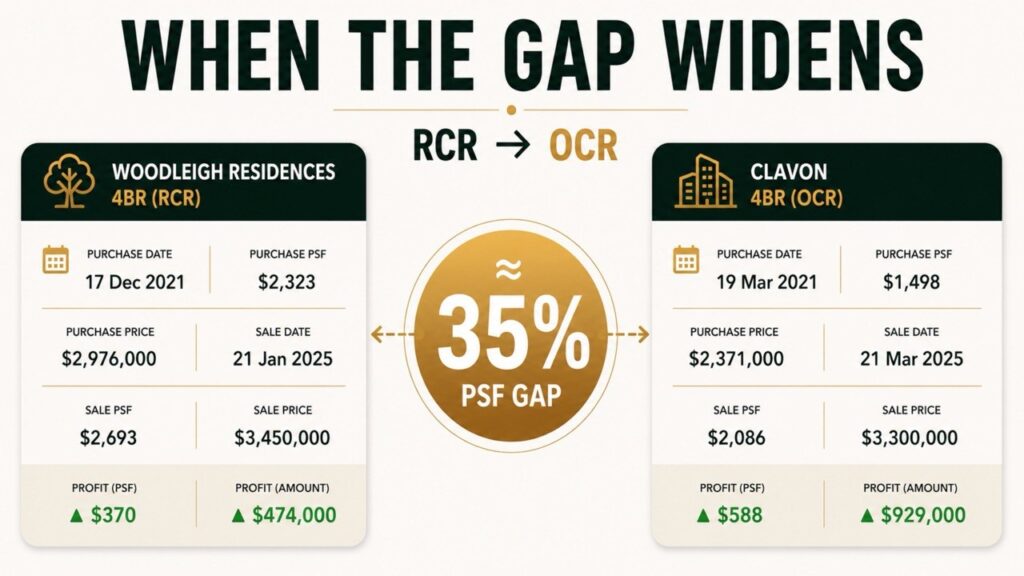
Instead of moving from RCR towards CCR, what if the buyer moved towards OCR?
The same Woodleigh Residences 4-bedroom example entered at:
$2,323 psf
A 4-bedroom unit at Clavon was purchased in March 2021 at:
$1,498 psf
That’s roughly a:
35% PSF gap.
Now the decision becomes very different.
The question isn’t merely:
Which property is cheaper?
Of course Clavon was cheaper on a PSF basis.
The better question is:
Was everything Woodleigh offered worth paying roughly 35% more for?
And conversely, what did a buyer sacrifice by moving to the OCR and entering at a substantially lower PSF?
That is the trade-off buyers should understand.
This Is Why We Believe Every Property Has a Walk-Away Price

We like good projects.
But we don’t believe there is a property worth buying at any price.
A project can have:
Good location.
Strong amenities.
Nice landscaping.
Efficient layouts.
Good schools nearby.
Strong transport connectivity.
But as its price rises, the alternatives available at the same budget begin to change.
And eventually, there may be a point where we’d rather buy something else.
We call this the walk-away price.
It isn’t necessarily one magical PSF number.
It’s the point where the value proposition changes enough that another option deserves serious consideration.
So What Happens If Thomson Reserve Reaches $3,000–$3,100 PSF?
This is where all of this becomes relevant to Thomson Reserve.
Imagine you’re choosing a unit and the one you want works out to around:
$3,000–$3,100 psf.
Don’t immediately ask:
“Is $3,100 psf expensive for Thomson?”
We’d ask four questions instead:
What are OCR alternatives selling for?
What are other RCR projects selling for?
How does Thomson Reserve compare with those RCR alternatives?
And how close are we getting to CCR options?
Suddenly, you’re no longer evaluating Thomson Reserve inside a bubble.
You’re evaluating what your same dollar can buy across Singapore.
That’s a much more useful comparison.
The PSF Gap Is Not a Buy Signal
There’s an important caveat.
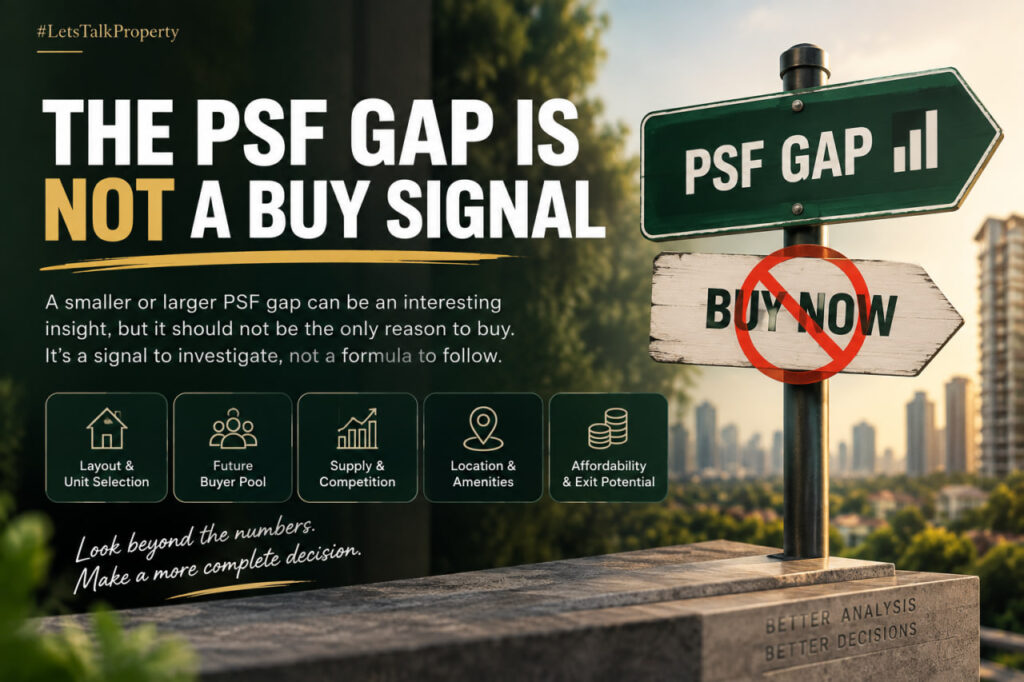
We are not saying:
Small gap = buy CCR.
Large gap = buy OCR.
That would be far too simplistic.
PSF itself can be distorted by unit size, layout, floor, facing, project characteristics and transaction timing.
Two properties at identical PSFs can still have completely different prospects.
The PSF gap is therefore a signal to investigate, not a formula that makes the decision for you.
Once we spot an interesting gap, we still want to study:
- Entry quantum and affordability
- Layout efficiency
- Unit selection
- Supply and future launches
- Competing developments
- Transformation around the area
- Future buyer pool
- Exit competition
- What future buyers can realistically afford
Because ultimately, we’re not trying to find the property with the lowest PSF.
We’re trying to find the property where the price makes sense relative to what buyers can choose instead.
Buy With Your Future Buyer in Mind

This is also why we think about exit strategy before buying.
Imagine Thomson Reserve reaches $3,100 psf today.
Several years later, you want to sell.
Your future buyer isn’t going to evaluate your unit alone.
They may compare it with:
another RCR resale,
a newer RCR launch,
a cheaper OCR alternative,
or even a CCR property if the price gap has narrowed.
The same comparison you’re making today will eventually be made against you when you become the seller.
That’s why we always come back to one question:
Would real buyers still want this later, given what else they could buy?
That’s a very different way of thinking about property.
Our Takeaway on Thomson Reserve

Thomson Reserve shouldn’t be judged simply by whether its launch PSF looks high or low.
The more important question is:
What is the price gap when it is actually your turn to choose a unit?
If Thomson Reserve reaches $3,000–$3,100 psf, we’d pause and map out the alternatives.
Not because Thomson Reserve suddenly becomes a bad project.
But because a good project and a good purchase are not always the same thing.
Price changes the decision.
And sometimes the best insight doesn’t come from studying the property you’re about to buy.
It comes from studying what else your money could buy instead.
That’s the PSF Gap Rule.
If you’re currently comparing Thomson Reserve or another new launch and aren’t sure where your own walk-away price should be, that’s exactly the kind of conversation we enjoy having.
We can look at your budget, the units you’re considering, competing projects and importantly, who might eventually buy the property from you.
No pressure to make a move. Just a clearer framework before you do.
📩 Book a 15-minute call (Zoom or coffee — your choice)
Let’s build clarity around your next move — not anxiety.
CLICK HERE 👉 QUICK 15-MIN CLARITY SESSION
Wondering if it’s the right time to buy, sell, or wait it out?
These decisions can be tough, and there isn’t a one-size-fits-all answer.
But don’t worry, that’s where we come in!
At Let’s Talk Property, we are here to provide clarity to you and guide you step-by-step in your real estate journey!
Whether you’re a first-time buyer or a seasoned investor, we hope to partner with you to create a clear plan that’s tailored to your unique needs and provide objective guidance to help you make the best real estate decision.
So, if you’re looking to buy, sell, or just want to chat about your real estate options, we’re here for you!
With our extensive on-the-ground experience, you can trust us to provide a top-notch real estate experience that’s both informative and stress-free.
Do contact us for a sharing session!
Best Regards,
Let’s Talk Property
Dillon @ 9389 1992
P.S. With so much UNCERTAINTY, Should you BUY, SELL or WAIT?
Find out more by clicking HERE
LIKE OR SHARE OUR FACEBOOK PAGE 🙂