The Government Just Changed The EC Market Again
Here’s What It Means For Buyers, Upgraders, And Future EC Prices
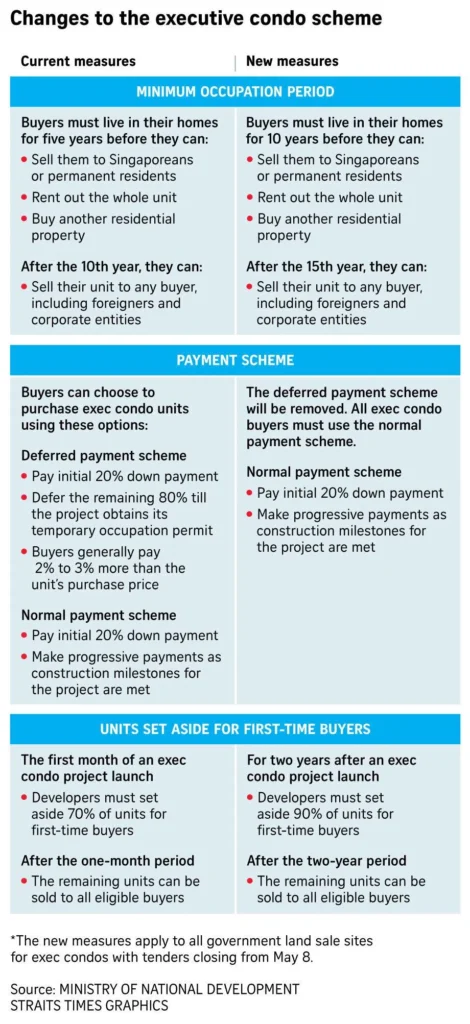
The government has announced 3 major changes to the Executive Condominium (EC) scheme for future EC GLS sites closing from 8 May 2026 onwards.
The 3 changes are:
- New ECs will now have a 10-year Minimum Occupation Period (MOP) instead of 5 years
- The Deferred Payment Scheme (DPS) will be removed
- First-timer quota increased to 90%, with priority purchase period extended to 2 years
At first glance, this may seem like just another policy refinement.
But if we really study the direction carefully… this changes the positioning of ECs quite a lot.
1) The Biggest Change: ECs Are Becoming More “Own Stay” Focused
Previously:
- EC owners could sell after 5 years MOP
- Full privatisation happened after 10 years
Now:
- MOP becomes 10 years
- Full privatisation only after 15 years
This is a very major shift.
Because historically, one reason why ECs became extremely attractive was the “privatisation effect”.
Buyers liked the idea that:
- they entered at subsidised pricing,
- held for 5 years,
- then potentially benefited from the resale and privatisation upside later.
Now the runway becomes much longer.
And this changes buyer psychology.
What does this mean practically?
It means future EC buyers must be more prepared for:
- longer holding periods,
- family planning stability,
- and genuine own-stay intentions.
In other words…
ECs are slowly moving away from:
“Buy cheap first then flip later”
towards:
“Buy this because you genuinely want to live there long term.”
And honestly, I think this was intentional.
2) Why The Government Is Doing This
If we read between the lines, the government is likely trying to preserve the original spirit of ECs.
Remember:
ECs were never meant to become a short-term wealth creation vehicle.
They were created as:
- an affordable transition between HDB and private housing,
- mainly for Singaporean households who exceeded HDB ceilings but still needed support entering private housing.
Over the years, ECs became extremely attractive because:
- pricing gap vs condos widened,
- privatisation stories became well known,
- and many buyers started viewing ECs almost like “discount private condos”.
Demand became very aggressive.
This policy shift feels like an attempt to:
- prioritise genuine owner occupiers,
- slow speculative demand,
- and preserve affordability for first-timers.
3) Removal Of Deferred Payment Scheme (DPS)
This is another important change that many buyers may not fully appreciate yet.
Previously, DPS allowed buyers to:
- secure an EC first,
- pay a smaller amount upfront,
- and only take the full loan later upon TOP.
This helped many HDB upgraders because:
- cash flow felt easier,
- they could delay selling,
- and monthly commitments felt lighter during construction.
Now with DPS removed:
- buyers will need stronger financial preparation upfront,
- affordability becomes more important,
- and bridging the transition becomes trickier for some families.
The hidden implication
This may reduce speculative or overly stretched buying behaviour.
Because previously, DPS lowered the psychological barrier to entry.
Without DPS:
- buyers may become more cautious,
- and developers may need to price more carefully depending on market conditions.
But at the same time…
This could also strengthen the quality of future EC demand.
Meaning:
buyers entering future ECs may generally be:
- more financially stable,
- more long-term focused,
- and less momentum-driven.
4) First-Timer Quota Raised To 90%
This part is actually very important for genuine first-time buyers.
The government is increasing:
- first-timer allocation from 70% to 90%
- and extending priority access from 1 month to 2 years after launch
This is a very strong signal.
The intention is clear:
future ECs are meant primarily for first-time Singaporean households.
Not investors.
Not aggressive upgraders.
Not short-term opportunistic buyers.
This means first-timers may now enjoy:
- better access to units,
- less competition from second-timers,
- and potentially more time to enter projects.
For younger couples genuinely planning for family formation, this is actually quite supportive.
So… Will Future ECs Still Be Worth Buying?
Personally, I think yes.
But buyers need to change HOW they evaluate ECs.
Previously, many people focused heavily on:
- privatisation upside,
- resale gains,
- and “future condo effect”.
Now I think the evaluation becomes more about:
- entry affordability,
- genuine livability,
- transformation potential of the township,
- MRT connectivity,
- surrounding future supply,
- and whether you can comfortably hold for 10–15 years.
The mindset shifts from:
“Can I exit fast?”
to:
“Is this a place I can confidently grow into?”
And honestly… that may not be a bad thing.
What Happens To Existing ECs?
This is the interesting part.
Because these changes only affect future EC GLS sites from 8 May 2026 onwards.
Meaning older ECs still retain:
- shorter MOP structures,
- earlier privatisation timelines,
- and in some cases DPS advantages from the past.
This may actually make certain existing and upcoming ECs more attractive in comparison.
Especially projects launched before these rules take effect.
I suspect many buyers will start comparing:
- “old EC structure”
vs
- “new EC structure”
very differently moving forward.
Final Thoughts
Policies rarely affect just one thing.
They affect:
- buyer psychology,
- affordability,
- supply-demand behaviour,
- and long-term market positioning.
And sometimes…
the biggest opportunities come from understanding the direction before the market fully reacts.
The EC market is no longer just about:
“cheap condo entry”.
It is increasingly becoming:
- a long-term family asset,
- a lifestyle decision,
- and a carefully managed housing bridge for Singaporeans.
Which means buyers today probably need more than just project information.
They need clarity on:
- timing,
- holding ability,
- exit flexibility,
- and how these policy shifts affect their own situation specifically.